Less Boilerplate, More Power: What's New in Loopstack v0.20
Less Boilerplate, More Power: What's New in Loopstack v0.20
Announcing Loopstack v0.20 with property decorators, JEXL expressions, explicit context namespaces, a unified project template, and a visual workflow debugger.
We’ve been listening to your feedback, and the theme of this release is simple: get out of your way.
This update trims the ceremony around defining blocks, gives your templates a proper expression language, and makes context access explicit and predictable. Here’s the rundown.
Decorators That Make Sense
The old @WithArguments and @WithState class decorators always felt a bit disconnected — you’d define a schema at the class level, then use it on a property somewhere else. We’ve fixed that.
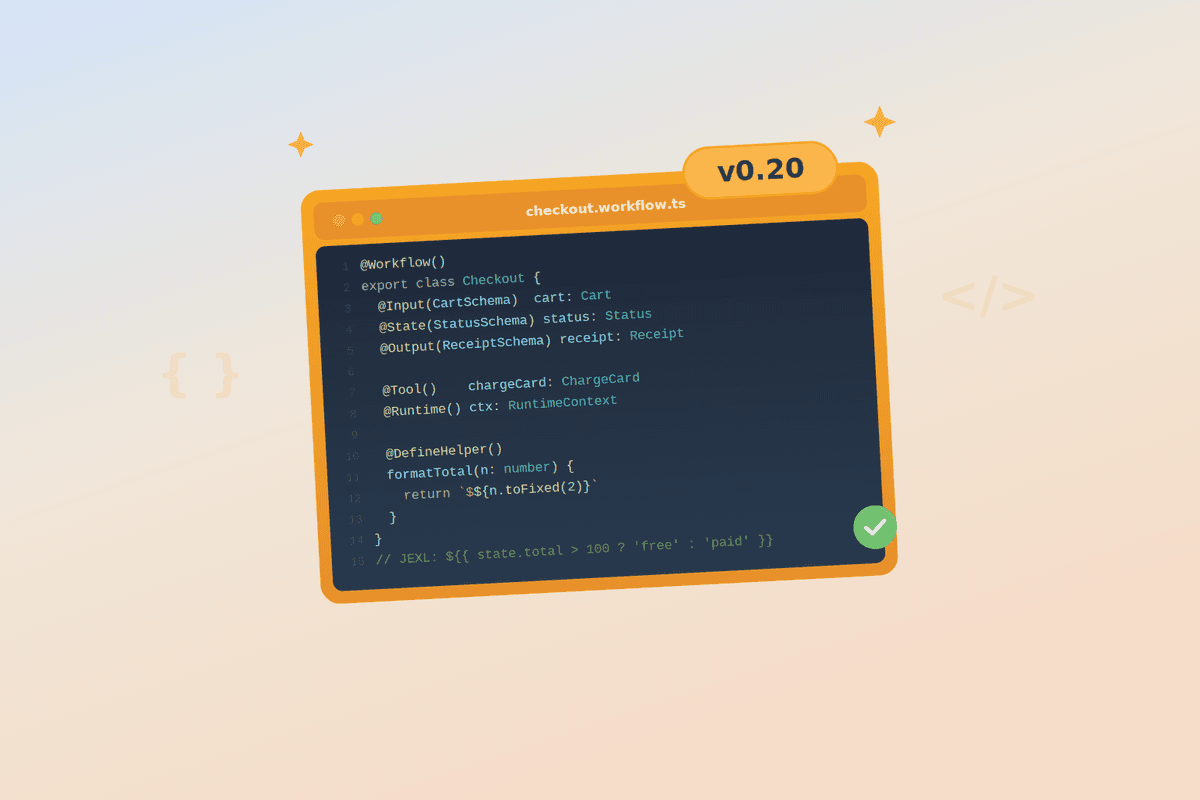
@Input and @State are now property decorators. You put them right on the property they describe. It’s a small change that makes the code read more naturally. And while we were at it, we dropped @Injectable() entirely. Every block type — Workflows, Tools, Documents, Workspaces — just works without it now.
We also added three new decorators. @Output() lets you define a workflow’s return value cleanly. @DefineHelper() lets you create custom Handlebars helpers that are immediately available in your YAML templates. And @Runtime() gives you direct access to runtime context like transition payloads.
A Real Expression Language
This is the big one. The old ${ } syntax was useful but limited — you could access properties and not much else.
We’ve replaced it with JEXL expressions (${{ }}), which give you comparisons, logic, arithmetic, ternaries, object and array literals, and string concatenation — all while preserving data types. A number stays a number. A boolean stays a boolean. No more coercing everything to strings and hoping for the best.
Handlebars is still there for inline string interpolation, and you can now extend it with your own helpers using @DefineHelper(). The built-in helpers we used to ship (eq, gt, add, formatDate, and friends) have been retired — JEXL covers those use cases natively, and custom helpers handle the rest.
Clearer Context, Fewer Surprises
Templates used to let you access state properties directly — {{ total }} would just resolve against the workflow state. That was convenient until you had a naming collision or couldn’t tell where a value was coming from.
Now everything lives under an explicit namespace: state., args., runtime., result.. It’s a bit more typing, but your templates become self-documenting. When you see {{ state.total }}, there’s zero ambiguity about what you’re reading.
One Project, One Command
We’ve merged the frontend and backend into a single project template. Previously you had to spin up a separate Docker image to run the frontend — that’s gone. Run npx create-loopstack-app my-project and you get everything wired up and ready to go. One repo, one dev server, no juggling containers just to get started.
Abstract Classes Are Gone
This one’s been a long time coming. Workflows, Tools, and other block types used to require extending abstract base classes. It added a layer of indirection that made the code harder to follow, especially for newcomers. That’s been removed entirely — your blocks are just classes now. Combined with dropping @Injectable(), the amount of framework-imposed ceremony is dramatically lower.
See Your Workflows
The frontend Studio now has a visual debugger that renders workflows as flowcharts. You can see the full shape of a workflow, trace transitions, and inspect state at each step. It’s the kind of tool that turns a 20-minute debugging session into a 30-second one.
Wrapping Up
This release is about reducing friction. Fewer decorators to remember, a more capable expression language, and explicit context that’s easier to reason about. If you’ve been putting off a refactor, this is a good time — the migration is straightforward and the payoff is immediate.
— Your Loopstack Team
Ready to join the conversation? Check out our GitHub , connect with us on Discord , and follow our journey on LinkedIn .