The Factory Mental Model for AI Automation
The Factory Mental Model for AI Automation
A way of thinking about AI work - and why we built Loopstack as a factory floor, not a workshop.
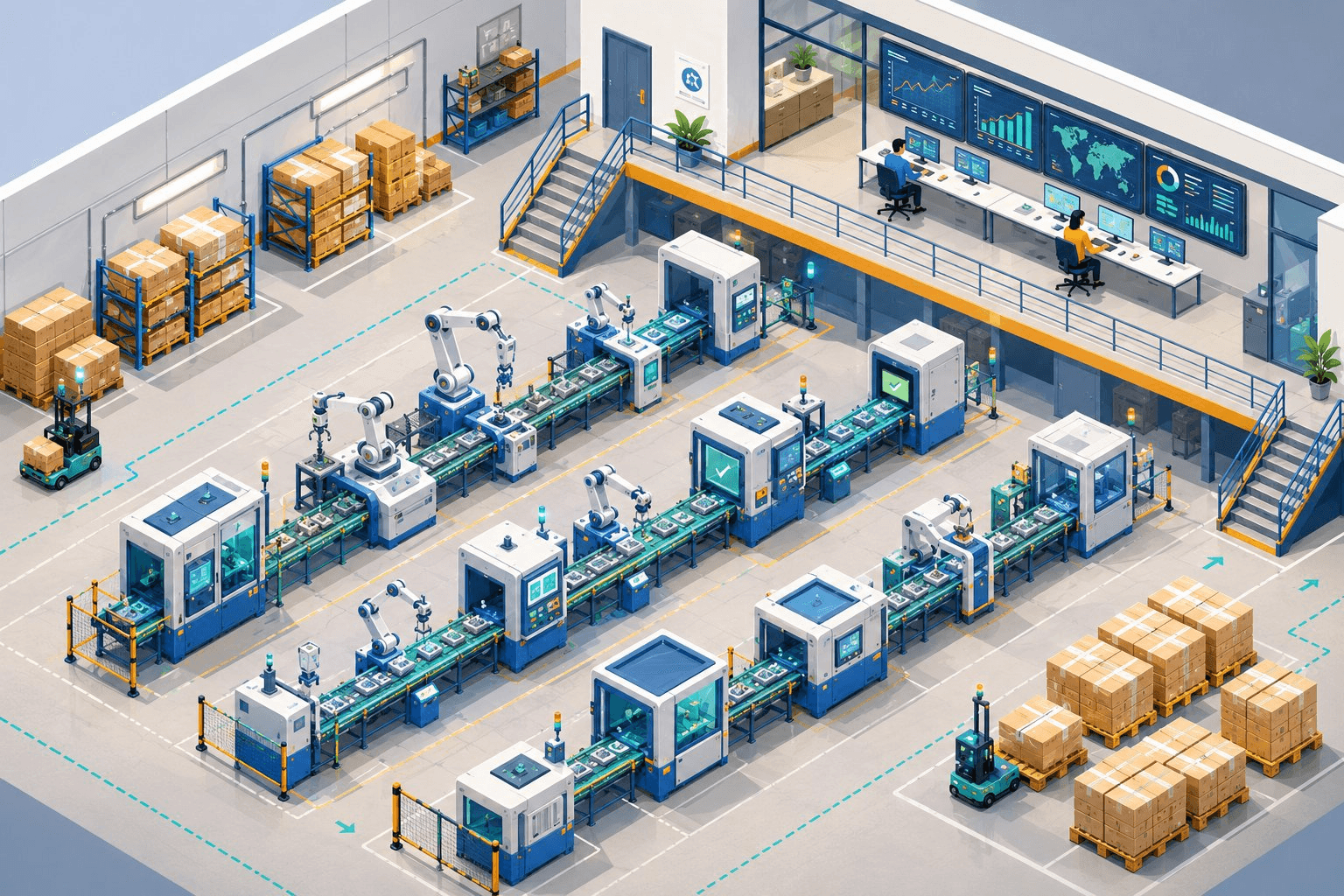
Most discussions about AI automation jump straight to the thing — the agent, the model, the prompt, the pipeline. We compare frameworks by their features. We argue about whether the right abstraction is a graph, a chain, a state machine, or a swarm.
Underneath these discussions sits a missing question: what kind of thing are we actually building when we put AI to work in a business?
Without an answer, teams default to whichever metaphor their tools came with. Build an “agent” and you’ll think of it as a digital employee. Build a “chain” and you’ll think of it as a script. Build a “graph” and you’ll think of it as a decision tree. Each metaphor shapes what feels natural and what feels awkward — and most of them strain badly the moment you try to run AI as a serious, ongoing part of how your business operates.
This post offers a different mental model. It’s not novel and it’s not clever; it’s borrowed from a domain that has spent two hundred years figuring out how to do complex, repeatable, reliable work at scale — manufacturing.
The model is this: AI automation, done seriously, looks like a factory.
What the factory model says
Picture a modern factory. Not a Dickensian sweatshop, not a science-fiction dark-factory, not a craft workshop. A working industrial plant in 2026. It has:
- A floor plan. The factory is laid out deliberately. Things are where they are for a reason. You don’t reorganize it on a whim.
- Production lines. Sequences of stations that transform inputs into outputs. Each line is designed, tested, commissioned, and improved over time.
- Stations. Specialized equipment that does one job well. Each has its own controls, safety interlocks, maintenance schedule, and operator credentials.
- Materials moving through. Raw inputs come in one end. Work-in-progress flows through the line. Finished output emerges the other side. Every unit is traceable.
- Job orders. The factory doesn’t run “in general.” It runs specific jobs: this product, for this customer, with these specifications, this week.
- A control room. Operators watch the lines, get alerted to problems, pause production, pull units for inspection, sign off on batches.
- Plant engineers. Highly skilled people who designed the lines, maintain the stations, and improve the operation continuously.
- Quality control. Inspectors, sampling, defect tracking. Trust is earned by measurement, not assumed.
This is what a factory is. Now apply it to AI work.
A production line is an AI workflow — a sequence of steps that transforms an input into an output, designed deliberately. Some steps are deterministic (look up a record, send an email). Some are probabilistic (an LLM summarizes a document, a model classifies a request). The line itself is engineered; individual stations may behave in different ways.
A station is a capability — a tool, an integration, a model call, a database query. Each does one thing well. Each has its own auth, its own retry behavior, its own permissions. You don’t pass raw data to a station; you give it a properly formed unit of work.
Materials are the data flowing through — documents, records, customer requests, support tickets, contracts. Each has provenance. You can trace which line processed which document, when, with what version of which station.
A job order is a bounded execution context — this customer, this dataset, this set of credentials, this set of permissions. The same lines can run for many job orders without contamination between them.
The control room is the operator interface — where humans watch what’s running, intervene when needed, approve sensitive steps, audit what happened. This is for the people operating the AI, not the people receiving its output.
Plant engineers are your developers — the people who designed the lines, who own the code, who improve the operation. Not external consultants. Not no-code citizen builders. Engineers who own the system.
That’s the model. Six elements that account for almost everything that matters about running AI in production.
What the factory is not
This is where the model earns its keep. A good mental model doesn’t just describe what something is; it predicts what it isn’t. The factory model has sharp edges.
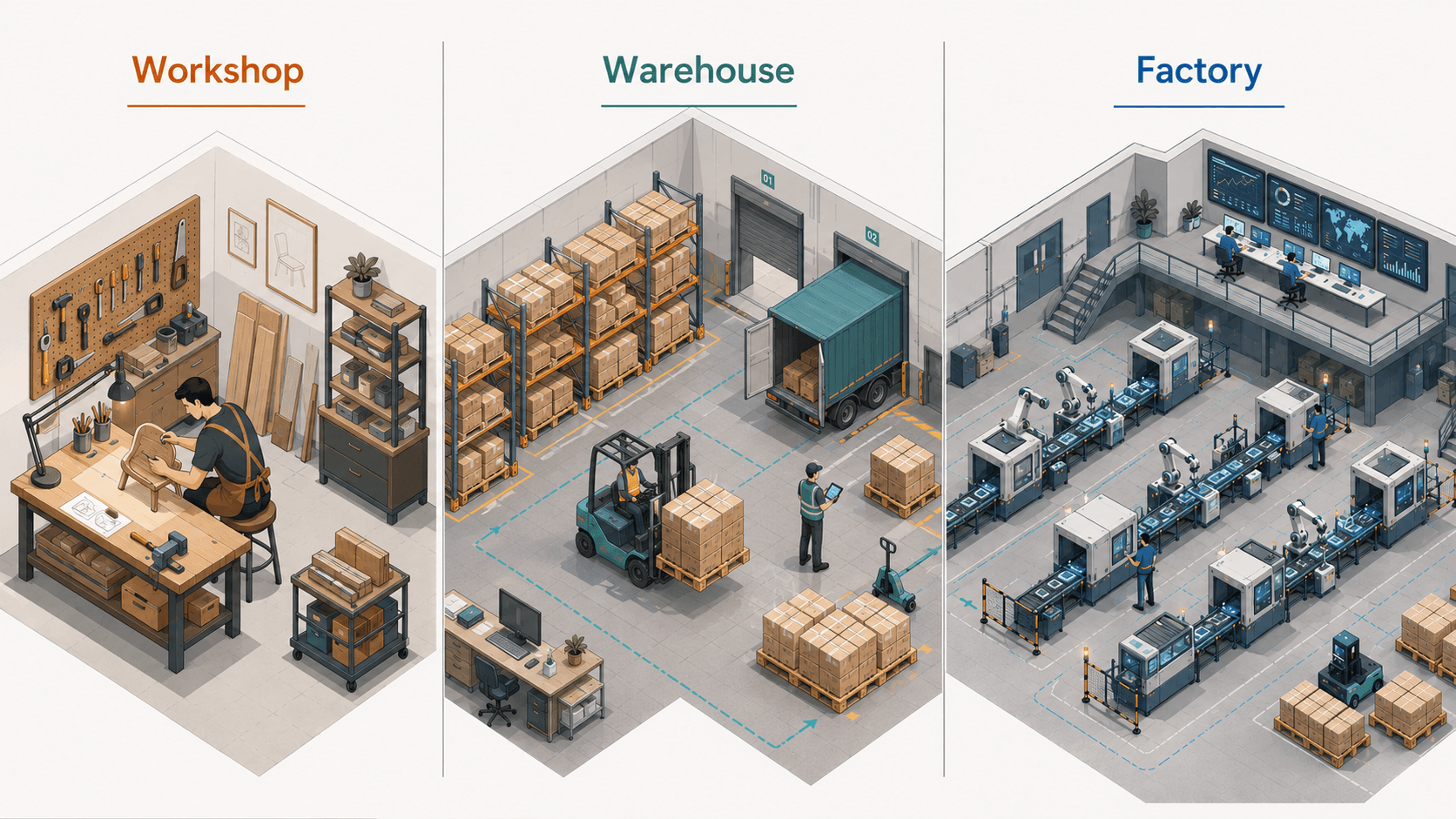
A factory is not a craft workshop. A workshop makes one-of-a-kind pieces, by hand, by an artisan. Every output is unique and that’s the point. There’s no production line; the craftsman is the production line. Workshops are wonderful — but they don’t scale, and the value of “every piece is unique” is the opposite of what you want when 10,000 customer support tickets need triaging tomorrow.
So if your AI use case is one-off custom work where every output is intentionally unique, you’re a workshop. The factory model doesn’t fit you and you shouldn’t force it.
A factory is not a science lab. A lab is for experiments — uncertain inputs, uncertain processes, uncertain outputs. You go to the lab to figure out whether something works. You build a factory when you already know it works and you need to do it reliably, repeatedly, at scale.
If your AI use case is exploring whether an approach is even viable, you’re in the lab. The factory model is premature. Prove it works first, then engineer the line.
A factory is not a retail store. A retail store has a polished public-facing showroom, marketing, end-user experience design. The factory produces what the store sells — but the factory itself isn’t customer-facing. You don’t invite end customers onto the factory floor.
If your AI use case is the AI experience itself is the consumer product — a chat interface, a creative tool, a public assistant — you’re building a store. The factory might be behind it, but it’s not the thing the customer sees, and your design priorities are different.
A factory is not a 3D printer in a garage. A 3D printer is wonderful for one-off prototypes by an individual. Quick, flexible, low overhead. But it’s not how you make 50,000 of something.
If your AI use case is a solo developer building a personal tool, you’re in the garage. The factory’s overhead doesn’t pay back at that scale.
A factory is not a warehouse. A warehouse takes other people’s products, sorts them, picks them, ships them. It’s logistics — moving things around without transforming them. A factory transforms inputs into outputs you designed.
If your AI use case is routing data between SaaS systems — when X happens in Stripe, do Y in Salesforce — you’re running a warehouse. That’s what Zapier, Make, and n8n exist for. Don’t reach for a factory metaphor when you need a conveyor belt.
Each of these “is nots” is generative. Once you have the factory model in your head, you can predict the answer to “is this the right shape of work for a factory?” without anyone telling you. That’s the test of a useful mental model.
How to apply the model — a generator, not a checklist
Once you have the factory model, you can use it to generate answers to questions about AI automation, instead of memorizing them. Here are examples of what the model predicts.
On feature scope: Does this feature have an analog on a real factory floor? If yes, it probably belongs. If no, it’s probably out of scope. “Should we support drag-and-drop visual workflow building?” Factories don’t get rearranged by management dragging stations around; they’re engineered. So the feature is probably a mismatch for this audience.
On the user interface: Who’s the user, and where do they sit in the factory? “Should the operator console focus on conversational AI experiences?” The console is the control room — the people there are operators, not end customers. The interface should prioritize observability, intervention, and audit, not marketing-grade chat UX.
On integrations: Is this a station bolted to the factory floor, or a vendor’s truck pulling up to the loading dock? Internal APIs, internal databases, internal services are stations — they belong in the operation. Generic SaaS connectors are vendor trucks — they’re routing concerns, not factory concerns.
On reliability: What happens when this fails at 3am with no one watching? Factories run unattended; they have alarms, fail-safes, and runbooks. Any AI operation that can’t survive overnight without supervision isn’t a factory yet — it’s still a workshop.
On the buyer: Is this buyer running an operation, or experimenting? Operations buyers ask about uptime, integration, audit, scaling. Experimenters ask about model quality, prompt techniques, novel architectures. Different buyers, different needs. The factory model is for the first group.
On scope of work: Is this work the same thing many times or different things once? Factories make the former. If a buyer’s use case is “every output is unique and custom,” they don’t need a factory; they need a workshop.
Notice what just happened. None of those answers required memorizing a feature list or a positioning doc. Each one fell out of the metaphor. That’s the test of a sticky mental model — it does the work for you.
And this is where Loopstack comes in
We built Loopstack because we kept seeing the same shape: engineering teams trying to build AI operations using tools designed for workshops. They’d start with an agent framework, build something impressive, then hit a wall the moment the work needed to run for multiple customers, integrate with internal systems, survive overnight, and be maintained by a team for years.
The walls were always the same. No real concept of a job order, so multi-tenancy was bolted on awkwardly. No real concept of a station, so every integration was a custom rewrite. No real concept of a control room, so observability and human-in-the-loop were afterthoughts. The frameworks were excellent for what they were — workshops — but they didn’t help you run an operation.
Loopstack is a NestJS-native framework for building custom AI systems with deep internal integration. That’s the technical description. The shorter version: Loopstack is the factory floor.
It gives you the floor plan (the framework structure). It gives you the production lines as first-class objects (workflows). It gives you stations that are typed, permissioned, and reusable (tools). It gives you job orders that scope an execution to a customer or dataset (workspaces). It gives you the materials handling that AI operations actually need (documents and data lifecycles). It gives you the control room where humans operate the system (the operator console).
And — crucially — it’s a framework for your engineers to build with, in code they own. Not a no-code platform. Not a SaaS that runs your operation for you. The plant engineers in this metaphor are your developers, and the factory is yours.
That’s the whole pitch, and it’s why we call it a factory floor rather than a “platform” or a “framework for agents” or anything else. The metaphor is the product.
Is Loopstack for you?
Use the model to answer for yourself. A few questions, each grounded in the metaphor:
-
Are you running an operation, or experimenting? Factories are for operations. If you’re still figuring out whether AI can do the job at all, you’re in the lab — and lab tools might serve you better right now.
-
Is the work the same shape, many times? Factories shine when the same process runs across many inputs and many customers. If your use case is one-of-a-kind every time, a workshop is fine and a factory is overkill.
-
Do you need to integrate with your own systems? Stations are bolted to your factory floor. If your AI work needs to call your internal APIs, your internal databases, your bespoke services — not just public SaaS connectors — that’s exactly what Loopstack is built for. If you mostly need to wire together third-party SaaS, a routing tool will be lighter.
-
Do you have engineers who’ll own this? Factories have plant engineers. Loopstack assumes your team will write code, design workflows, and maintain the operation. If you’re hoping for citizen builders to assemble AI by drag-and-drop, this isn’t the right tool.
-
Are you on TypeScript / Node, and do you care about clean structure? Loopstack is NestJS-native. Teams that already work in that idiom will find Loopstack feels like home; teams that don’t won’t get the same leverage from it.
If you answered yes to most of those: you’re building a factory, and we’d love to help.
If you answered no to most of them: you might be in the lab, the workshop, the warehouse, or the garage — all legitimate places to be, but different operations needing different tools. We’d rather tell you that honestly than try to sell you a plant you don’t yet need.
What we hope you take away
Not “Loopstack is great” — that’s for you to decide. The thing we hope sticks is the model itself.
The next time you’re in a meeting about AI automation, and someone says “we should add an agent for this” or “let’s chain these prompts together,” try translating to the factory model. Ask: what station is this? what line is it on? whose job order does it run under? who’s in the control room when it runs? You’ll find that some ideas suddenly make sense and others suddenly look incomplete — and the conversation gets sharper.
That’s what mental models are for. Not for marketing. For thinking clearly about hard things.
If the model resonates, and the questions above pointed you toward a factory rather than a workshop, take a look at Loopstack. We built it because we wanted this model to be more than a metaphor — we wanted it to be the actual shape of the code.
Your Loopstack Team